March 8th
God, thank you for the gift of this day. May our hearts and minds be open to what you want us to receive, and may these words I share bring honor to you. Amen.
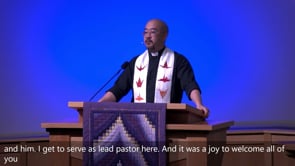
Today is International Women’s Day. When I realized that I was being invited to speak on International Women’s Day, as someone who identifies as a woman, I admit that I didn’t think much of it. I realize I have a hesitation in making a big deal around women’s rights and roles because, I don’t know, maybe I have internalized some messages that tell me that it’s unbecoming or that it’s not socially acceptable to speak up for women? Or that women already have equality and what else do we want? Anyway, as I prepared for reflecting on this passage from scripture, I changed my mind. And that is something that women stereotypically like to do!
A little background on me is that the church I grew up in did not permit women to teach adult males, or to preach, or to be a part of governing boards that discern major decisions for the church. Now for my part, spending most of my life in a church that limited women’s roles was the air I breathed. I didn’t think about seeing women in different roles in the church because I didn’t have any imagination for anything different.
My transition in changing my mind came slowly as I learned through listening to others’ stories of being hurt by male leadership, through studying scripture from a feminist lens, through hearing women preach, and through receiving an imagination for different possibilities for women. Coming to this church was part of celebrating a different way of believing and being, and it’s a joy to be here on International Women’s Day in a church that invites the strengths and gifts of women at all levels of ministry.
We are on week three of our Lenten focus on resistance. Today, as we look at the story of the Woman at the Well, we are exploring resisting division. It’s safe to say that when we consider our politics, the environment, war, issues of sexuality, and much more our communities are really divided on a lot of issues. These divisions bring about destruction and dehumanization, and they fuel hate and prejudice, both at institutional and personal levels. And as people who profess the importance of following Jesus, of speaking up for justice, and of creating belonging for all, it’s important to consider how we posture ourselves to resist division.
As a seminary student, I study the history, theology, and sociology of beliefs and cultural norms of the church, as well as the different arguments involved. I have found it to be a good practice to visit the space between the two sides—we could call it a bridge between divides—or we can call it a “liminal space.” A liminal space exists at the edge of a divide—it’s the place where arguments can live in tension. If we can stay here and be with the tension and if others can be there with us, this liminal space can also be a place of possibility.
Our story today about the encounter between the Samaritan woman and Jesus sits in this middle space, and the interaction between these two people shows that we resist division through loving encounter in the liminal space.
The Woman at the Well in John 4 is a very familiar story. At its most basic level, Jesus has an interaction with this Samaritan woman at the well. He offers her living water. He reveals that he is the Messiah. She runs back into her village to tell everyone and many Samaritans come to believe in Jesus as the Savior of the World. That’s the main summary. But in light of hanging out on the bridge and looking at loving encounter, here’s some things that stand out.
First of all, in vv. 3-4, we learn that Jesus is traveling from one place to another and stops somewhere in between to rest—a place called Samaria. Already we can see that the story happens in an in-between, a liminal space, a bridge between places.
So, Jesus is resting at this well in Samaria, and v. 9 specifically tells the reader that Jews and Samaritans do not get along. There is a long history of religious disagreement over sacred texts, and over which temple should be used for worship. These conflicts have led to violent acts and hostility between the Jews and Samaritans for many years. These two people groups are historically, culturally, and religiously declared enemies. However, vv. 5-6 tells us that this well where these two encounter one another holds some kind of significance to Jacob, father of Joseph. The Samaritans understood themselves as descendants of Ephraim and Manasseh, also sons of Jacob, so this well holds significance for both Jews and Samaritans. The author may be implying that this is a place of shared ancestry. It is literally common ground, a bridging space.
Even though these two supposed enemies are in a place of common ground, Jewish purity laws say that a Jewish man should not even speak to this Samaritan woman because she would be considered ceremonially unclean. And yet, Jesus tells her to give him a drink from the water. She knows purity laws and knows she cannot share her drinking vessel with him. And yet, by initiating conversation and acknowledging his need to her, Jesus makes himself vulnerable to her and lets her decide how she might respond.
As she engages and pushes back at Jesus with questions, they have this interesting conversation. Here is Jesus, treating her as a worthy conversation partner. In fact, if you read the whole text—we just read a small part of their conversation—this is one of the longest dialogues recorded with Jesus! We see Jesus subverting and resisting his prescribed role as a Jewish male in an encounter with a “lesser” person by gender, ethnicity, and religion.
Jewish culture doesn’t permit this behavior or reward it, so the whole encounter doesn’t really even make any sense. And that’s what exciting about being in a liminal space—Jesus shows us that when we resist restrictive, prescriptive roles that assert authority or rightness over others, a new and different kind of encounter is possible.
Eventually, Jesus tells her to get her husband, and he tells her that he knows she has had 5 husbands and is now living with someone who she is not married to. Here is another area of tension for readers. Commentators often discount the Samaritan woman because of the supposed immorality of her relationship status. But there are so many possible reasons for her complicated relationships. This woman may have been divorced—a process controlled solely by men. Husbands may have died, and she would be passed to the brother, who likely already has a wife. In this time and cultural context, most women were dependent on men for provision and safety, so being with a man was not about gaining a lover—this was how a woman survived. What’s probably safer to assume about her is not that she’s immoral or promiscuous or a “difficult” woman, but that she has likely experienced real loss, heartache, maybe abuse, maybe isolation from others, and pain.
As I look to Jesus in this story, he does not condemn her. In fact, other commentators suggest that his purpose in acknowledging her relationship history and status proves to her that he really sees her and that he knows her story. This revelation enables her in turn to see her opponent Jesus in a new light. To see the truth of who he really is.
This is the first person that Jesus professes that he is the Messiah to. That’s notable! To some unnamed Samaritan woman?! He offers her living water and she wants it! And what does she do with this new understanding? She leaves her water jug—a symbol of her putting off and resisting her dependence on material goods—and runs to tell her people! This is what disciples do: they encounter Jesus, they experience some kind transformation, and they go share that. Jesus didn’t have to tell her to do this—she is bold and confident as she heads back to her village.
This is a beautiful and life-transforming example of encounter in the liminal space. Jesus resists his prescribed roles in subversive ways. He sees into the story and heart of this unnamed woman who becomes open, interested, and brave. This undervalued woman, who has come to quench physical thirst, engages with curiosity and experiences transformation that quenches her spiritual thirst and motivates her to share this living water with others. Beyond that, she becomes a living bridge of the gospel message to her own supposedly-rejected people group. Thanks to her courage and her words, the Samaritans are able to experience Jesus’s living water for themselves.
The living water that the Samaritan woman says “Yes” to is the gift of God’s own presence. In our own work of bridging division, we need this living and active source—found in Christ—to empower us with God’s heart as we move into the liminal spaces and possibilities for transformation.
As we have been exploring this Lenten theme of resistance, Pastor Joe has invited us to consider resistance not as performance, but resistance that comes out of our formation and through the rootedness found in our faith. This living water is not meant just as a marker of eternal life. It is accessible strength for the here and now, and the resource that helps us as we seek to resist division by entering the bridge space, the liminal space, into possibility and transformation. The tendencies to separate, to judge, to gossip, to hate, and to dehumanize are challenging to resist. We are not going to eliminate all the divisions between ourselves and others. But we get to choose what words and actions we put into the space between ourselves and the other. We resist division by accessing the living water of Christ that empowers us to see the image of God in the other, whether it’s someone we see on TV, someone on the other side of a protest, or someone sitting across from us at a family gathering.
Here are your 3 action steps for this week. Here is a piece of art that Scott Erickson gave us permission to use for visualization this morning. Check out this bridge.
Step 1 reflects on what we learn from Jesus:
Imagine division differently.
Loving encounter opens up possibility. When you think about a person or group or issue of division, who or what is on the other side of that bridge for you? Notice that there is light on both sides of the bridge. Where is there common ground and what might help you see that the sacred lives in that person, those people, just as the sacred lives in you? How might you resist the need to be more right or more smart or more well-researched? Can you allow yourself to be vulnerable?
Step 2 reflects on what we learn from the Samaritan Woman:
Don’t underestimate yourself.
Even as an unnamed woman in this story, Jesus affirms her as a worthy partner in this bridgework and their interaction leads to the transformation of many others. Dare to imagine that God has and will equip you to face conflict or build new bridges with the courage and strength already within in you. The work varies by person. For those of us who are used to being heard and think we hold the answers, pull back and listen more. And for those of us who already pull back because we tend to underestimate ourselves, do some discernment, then take a bold leap!
Step 3—look at the bottom of the picture and reflect on what we take from the living water.
Be rooted in Christ.
As we continue in Lent, perhaps you are participating in the laying aside what distracts you from God or adding in spiritual practices or disciplines in order to stay grounded in Christ for your provision. How might you form your days around drawing from that deep, spiritual well to strengthen you as you face divisive situations? As Pastor Joe reminded us last week, we don’t do any of this alone. Look at the light on the bridge. God is in all the spaces between and will go before you and will be with you.
As I close here, I want to invite you into a time of visual reflection. I invite you to close your eyes or drop your gaze. Place your body in a comfortable position. Take a few deep breaths and try to relax your hands, your shoulders, your jaw. I invite you to imagine that you are looking out over a horizon. You see a big chasm in front of you? Who or what is on the other side of this divide for you? Maybe it is a person or group that you have become distanced from because of conflict, or by differing views, or maybe it’s a bridge you’ve been too scared to cross. Pick one bridge that doesn’t feel too extreme. What is the measure of that distance, what kind of feelings come up when you think of trying to cross that divide?
Now look down at your feet. There in front of you is a slow, calm creek of clear, appealing water. You sense an invitation and desire to step into the creek. The ground is smooth and sandy, the water feels incredibly refreshing, unlike any water you have encountered before. You feel refreshed and rejuvenated. As you soak in this deep sense of renewal, you notice Jesus is near, and he is standing in the water too. Where you saw a divide earlier, you now see a sturdy bridge completely connecting the sides, and Jesus is somehow both right next to you and is already on the bridge as well. What kind of invitation is coming from Jesus? Is there a word or feeling that comes to you? You might imagine a kind hand on your shoulder or a spoken reminder: I am with you and I am for you.
My prayer for us in these times of great division is that we would know the presence of Christ, that we would look to be rooted in Christ, and that we might be empowered in our rootedness to put ourselves in the places where the gospel message can transform us and bridges that which feels impossible. God help us as we seek to be people who boldly move toward more loving encounter in the middle spaces. Amen.